
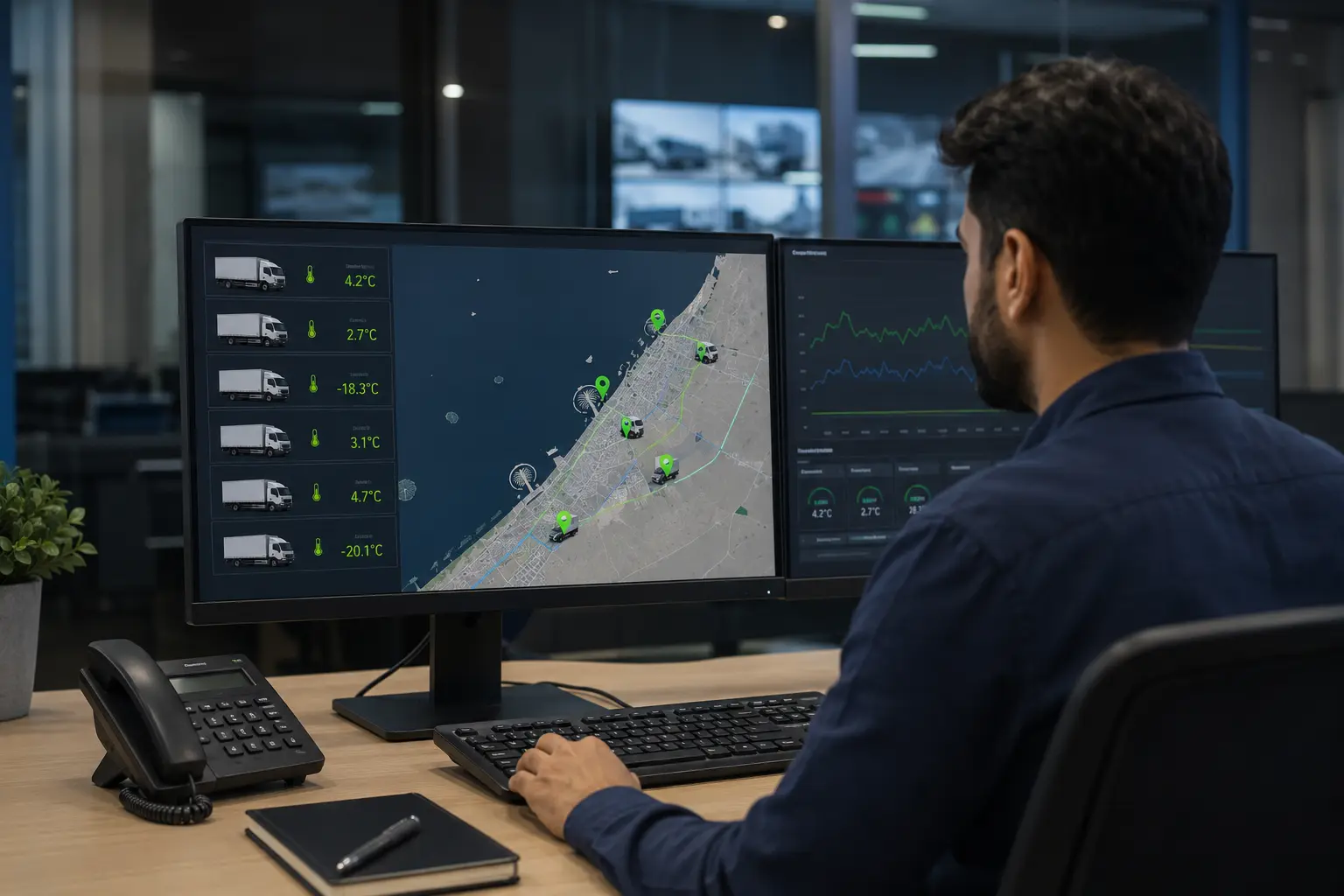
A refrigerated truck maintaining -18°C in 48°C ambient heat is holding a 66-degree temperature differential, continuously, for the entire trip. That is one of the largest sustained thermal gradients any commercial refrigeration system on the road is expected to manage, and it means the margin between “working normally” and “quietly failing” is much thinner than most cargo owners assume. In UAE conditions, the difference between catching a problem in its first ten minutes and discovering it after delivery is often the difference between a routine service call and a total write-off of the load.
This is why real-time GPS and temperature telematics have moved from a nice-to-have feature to a baseline requirement for any refrigerated fleet operating in the UAE. Here is what that technology actually does, why passive temperature logging is no longer good enough, and what a well-run response looks like when an excursion is detected mid-route.
Why Passive Logging Isn’t Enough Anymore
Older cold chain operations relied on data loggers that simply recorded temperature internally, to be downloaded and reviewed after the delivery was complete. That approach can prove what happened, but it cannot prevent anything. If a compressor starts failing at hour one of a four-hour route, a passive logger tells you about it at hour four, when the cargo is already compromised. Real-time telematics, by contrast, streams temperature, location, and mechanical status continuously, giving dispatch a chance to intervene while the trip is still in progress.
What a Modern Reefer Telematics System Actually Tracks
Refrigeration units from manufacturers like Thermo King and Carrier now integrate directly with onboard telematics gateways that pull data from the unit’s control board in near real time. The volume of information available goes well beyond a single temperature reading.
| Data Category | What It Tracks | Why It Matters in UAE Heat |
|---|---|---|
| Cargo temperature | Supply air and return air temperature inside the hold | Flags drift toward the legal limit before a full excursion occurs |
| Location and geofencing | Real-time GPS position, route adherence, stop duration | Confirms delivery windows and flags unplanned extended stops in extreme heat |
| Door status | Open and close events with timestamps | Every door-open event in 45°C+ heat lets in hot, humid air that the unit must then work to remove |
| Mechanical health | Compressor run time, condenser pressure, fuel level, operating mode | Early indicator of condenser fouling, low fuel, or a unit switching out of continuous cooling mode |
This is also why the fleet’s GPS tracking and temperature monitoring should be treated as a single system rather than two separate features. Knowing a truck’s exact location matters far more when you also know its cargo temperature is trending upward, because it tells dispatch exactly where to intercept the vehicle if a swap-out or emergency response is needed.
The Graduated Alert Approach
Rather than waiting for a hard breach of the legal temperature limit, a well-configured monitoring system escalates in stages, giving dispatch the maximum possible window to act before cargo is actually compromised.
- Early advisory: Temperature drifts within a couple of degrees of the limit. Dispatch is notified and can check in with the driver.
- Active warning: The threshold is breached. Dispatch and the driver coordinate an immediate check of the unit, condenser, and door seals.
- Critical alert: The excursion sustains beyond a set time window. This triggers a formal response protocol, including notifying the client and preparing contingency options.
The value of this staged approach is that most excursions are caught and corrected at the first or second stage, long before they become a client-facing incident.
What Actually Fails: The Real Causes of Excursions in UAE Heat
Understanding what typically goes wrong helps explain why continuous monitoring matters so much in this climate specifically.
Condenser Fouling
Fine sand and dust accumulate on condenser coils, especially in industrial areas. This insulates the coil, forcing the compressor to work harder to reject heat, and can push it into thermal shutdown during peak summer load. Weekly condenser cleaning is standard practice on well-run fleets for exactly this reason.
Door Seal Degradation
Rubber seals crack and lose elasticity under UV exposure and constant use on multi-stop routes. A degraded seal lets a continuous trickle of hot, humid air into the hold, which the unit then has to remove on every cycle.
The “Dark Period” Problem
Any time a refrigeration unit is switched off, whether during loading, a border stop, or a driver break, the cargo hold starts absorbing ambient heat immediately. In 45°C conditions, even 30 to 40 minutes without power can shift internal temperature by several degrees, which is enough to invalidate a narrow-tolerance shipment like pharmaceuticals or dairy.
Uneven Loading
Pallets stacked too close to the evaporator or blocking airflow to the rear of the hold create hot spots. The front of the load can read well within range while the back is already several degrees warmer.
What a Correct Emergency Response Looks Like
When an alert does escalate to a real excursion, the response needs to be fast and structured, not improvised.
- Stop and assess. The driver safely stops and checks for an obvious cause: a blocked condenser, a jammed door seal, or a tripped unit that may need a single reset.
- Notify immediately. Dispatch and, for sensitive cargo, the client’s own team are informed as soon as the issue is confirmed, not after the delivery is complete.
- Decide on salvage versus replacement. If the unit cannot be restarted, the fastest option is usually dispatching a second refrigerated vehicle to cross-load the cargo rather than waiting on a roadside repair.
- Hold and inspect on arrival. Any cargo that experienced a documented excursion is inspected before delivery, not delivered by default. The temperature log itself, not a visual check, is what determines whether the product is still usable.
The single biggest difference between an operator who handles this well and one who doesn’t is whether the excursion was caught by telematics in real time or only discovered after the fact. Every minute of head start matters when the ambient temperature outside is working against you.
Maintenance Discipline: The Other Half of the Equation
Technology catches problems early, but it cannot substitute for a maintenance schedule built around UAE conditions. On a well-run fleet, condenser coils are washed weekly, door seals are inspected on every pre-trip check, and every vehicle is pre-cooled to its target setpoint for a minimum period before loading begins, never after. These are unglamorous, repetitive tasks, but they are the actual reason some fleets rarely have excursions while others have them constantly.
Choosing a Fleet Built for This
At UAE Chiller, every vehicle in our fleet is GPS-tracked and fitted with Thermo King or Carrier refrigeration units, giving dispatch full visibility over location, temperature, and mechanical status on every trip. Our fleet is DM Card and ADAFSA certified, and we support over 1,000 businesses across the UAE, including major operators like ADNOC, DP World, Emirates Flight Catering, Noon, and Radisson Blu, who rely on us specifically because temperature failures are not an acceptable outcome for their supply chains.
Whether you need a chiller van for urban multi-drop delivery or a chiller truck for bulk distribution, every vehicle we dispatch carries the same real-time monitoring standard. Rates start from AED 350 per day, with same-day availability and driver options across all seven emirates.
If you want to see exactly how our monitoring works before you book, or need a fleet solution for a route with tight temperature tolerances, contact us at +971 52 525 5786, email info@uaechiller.com, or get a quote below. We are available 24/7 via WhatsApp and phone.
Need Reliable Refrigerated Transport Across the UAE?
Get a free quote for chiller van, truck, or trailer rental across all 7 UAE emirates. DM Card certified fleet, 24/7 available.
Get a Free Quote