
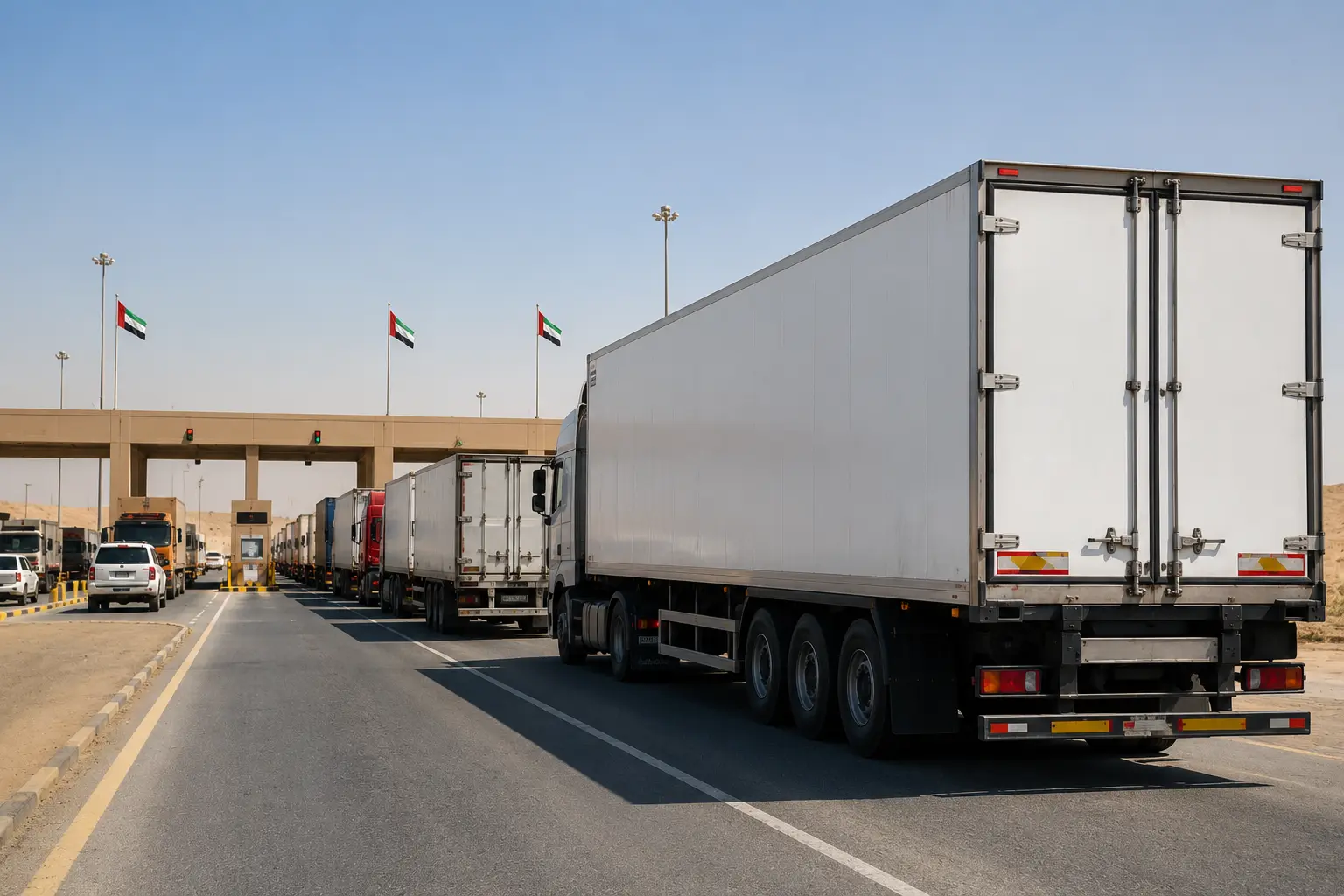
Moving chilled or frozen cargo from the UAE into Saudi Arabia, Oman, Qatar, Kuwait, or Bahrain looks straightforward on a map. In practice, it is one of the most operationally demanding legs in the entire cold chain, because a shipment that is perfectly compliant at the moment it leaves a Dubai or Abu Dhabi warehouse can be legally rejected a few hours later at a land border, purely on a documentation or shelf-life technicality that has nothing to do with the actual temperature of the product.
This guide sets out exactly what determines whether a cross-border refrigerated shipment clears or gets turned back at a GCC land border: the customs documentation you need in order, the shelf-life rules that differ by destination country, and the specific vulnerabilities that cause temperature excursions during transit.
Why Cross-Border Cold Chain Is Different From Domestic Transport
A domestic delivery inside the UAE typically takes a few hours, and the cargo is in a controlled environment from loading dock to receiving dock. A cross-border GCC shipment can spend anywhere from several hours to several days in transit, exposed to customs holding areas, physical inspections, and queue time at the border itself, all in ambient heat that regularly exceeds 45°C. Every one of those hours works against the product’s remaining shelf life and against the thermal stability of the refrigeration unit.
The Main GCC Land Border Crossings
Cross-border refrigerated freight from the UAE moves through a small number of critical highway corridors, and knowing which one applies to your route determines your documentation and timing expectations.
| Route | Border Crossing | Typical Clearance Time |
|---|---|---|
| UAE to Saudi Arabia | Al Ghuwaifat / Al Batha | Variable, can extend to multiple days during high inspection volume |
| UAE to Oman | Hatta / Khatmat Malaha / Tibat | 1 to 2 days |
| Saudi Arabia to Qatar | Abu Samra | Variable, dependent on Saudi transit clearance |
| Saudi Arabia to Kuwait | Nuwaiseeb / Abdali | Can extend due to strict health inspection sampling |
| Saudi Arabia to Bahrain | King Fahd Causeway | 1 to 2 days |
Al Ghuwaifat is the busiest and most consequential of these crossings, since almost all UAE-to-Saudi road freight, and much of the onward freight into Qatar, Kuwain, and Bahrain, passes through it. Delays there ripple across the entire regional supply chain, which is why experienced operators build buffer time into their shelf-life calculations rather than assuming a best-case transit window.
Shelf-Life Rules: The Number That Decides If Your Cargo Clears
The single most important figure in cross-border cold chain planning is Minimum Remaining Shelf Life (MRSL), the proportion of a product’s total shelf life that must still remain when it reaches the destination country’s border. This is not the same figure across the GCC, and getting it wrong is the single most common cause of cargo rejection at the border.
| Destination | Typical MRSL Requirement | Operational Note |
|---|---|---|
| UAE (import) | 1/3 of total shelf life, or 3 months minimum, whichever is greater | Applies mainly to packaged food entering the country |
| Saudi Arabia | 50% of total declared shelf life; absolute minimum 3 months if total shelf life is under 6 months | Strictly enforced; frozen meat and poultry additionally capped at 4 months from date of slaughter |
| Kuwait | Generally 50% | Vacuum-packed chilled red meat allowance recently extended to 90 days post-slaughter |
| Qatar | Generally 50% | Governed by the unified QS 10050:2025 standard |
| Oman / Bahrain | Generally 50% | Category-specific exemptions apply; confirm with destination authority before shipping |
The practical implication is straightforward but easy to underestimate: a product with 21 days of total shelf life that spends 5 to 10 days moving through production, cross-docking, and border clearance may already have less than 50% of its life remaining before it even reaches the Saudi border. This is a scheduling and packaging problem as much as a transport problem, and it needs to be solved before the truck loads, not discovered after it is rejected.
The Documentation That Prevents Border Delays
Missing or inconsistent paperwork is the most common cause of a shipment being held at the border, and every hour a refrigerated trailer sits in a customs queue is an hour its refrigeration unit is fighting extreme ambient heat under continuous load.
- Commercial invoice and packing list matching the physical load exactly. Generic product descriptions trigger physical inspection.
- Certificate of Origin issued by a recognized chamber of commerce, required to claim GCC customs union exemptions.
- Road waybill (CMR) matching the driver and vehicle identification on file.
- Halal certificate for meat, poultry, and gelatine-derived products, issued by an accredited body recognized by the destination country.
- Phytosanitary and health certificates for plant and animal-origin products, often requiring pre-shipment inspection.
- Import licenses and product registration confirming the specific formulation and label are legally registered in the destination market.
- Customs duty proof (Makasa in the UAE) confirming duties were already paid on entry to the GCC customs union, preventing double taxation on re-export by road.
A shipment held at the border for documentation review is not a paused shipment. It is a shipment actively losing thermal margin. This is why the paperwork should be finalized and verified well before the trailer departs, not assembled while the truck is already queued.
What Actually Happens During a Physical Inspection
If a customs officer flags a discrepancy that cannot be resolved electronically, the next step is a physical inspection, and this is the most dangerous moment for the cold chain. Opening a refrigerated trailer’s doors in 45°C ambient heat, even for 20 to 30 minutes, allows a substantial volume of hot, humid air to infiltrate the cargo hold. Cargo positioned near the doors absorbs this heat directly, and the refrigeration unit then has to work to recover a stable internal temperature while the truck may still be stationary and queued. For high-risk categories such as raw meat, seafood, or pharmaceuticals, inspectors may also pull physical samples for laboratory testing, which can add days rather than hours to the clearance timeline.
Choosing the Right Vehicle for Cross-Border Runs
Cross-border GCC freight is generally not suited to smaller urban delivery vans. Longer transit distances, extended time at ambient temperature during border processing, and the need to consolidate volume into fewer trips all favor larger, heavily insulated vehicles with the thermal reserve to withstand extended stops. A 20-ton to 25-ton chiller trailer, maintaining -18°C to -25°C, gives cargo the largest possible thermal buffer against the unpredictable delays inherent to land border crossings, and is the standard equipment class for GCC line-haul freight.
Working With a Cross-Border Ready Fleet
At UAE Chiller, our chiller trailer fleet is built for exactly this kind of run. Every vehicle is DM Card and ADAFSA certified, GPS-tracked, and fitted with Thermo King and Carrier refrigeration units capable of holding -18°C to -25°C through extended transit and border delays. We operate across all seven emirates and support cross-border GCC routes, and we are trusted by major regional operators including ADNOC, DP World, Emirates Flight Catering, Noon, and Radisson Blu for temperature-critical freight.
Our chiller trailer rental fleet is available with driver options and same-day dispatch, and our chiller truck rental range covers 3-ton to 10-ton vehicles for smaller cross-border loads. Rates start from AED 350 per day, with dedicated pricing for long-haul and cross-border contracts available on request.
If you are planning a cross-border shipment into Saudi Arabia, Oman, Qatar, Kuwait, or Bahrain and want to confirm the right vehicle, documentation checklist, and realistic transit timeline before you book, contact us at +971 52 525 5786, email info@uaechiller.com, or request a quote below. Our team is available 24/7 via WhatsApp and phone.
Need Reliable Refrigerated Transport Across the UAE?
Get a free quote for chiller van, truck, or trailer rental across all 7 UAE emirates. DM Card certified fleet, 24/7 available.
Get a Free Quote